
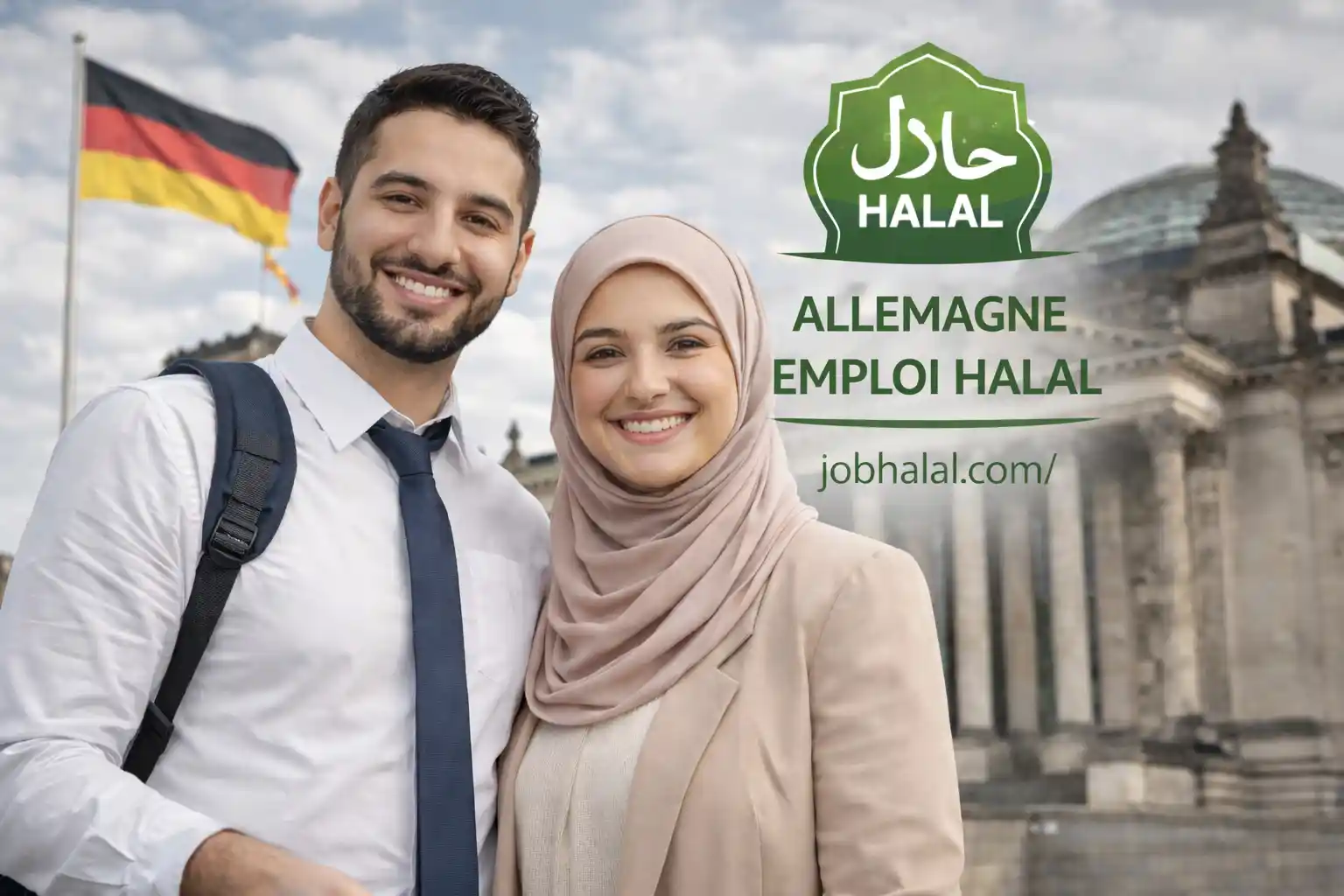
Germany is home to one of the largest Muslim populations in Europe. People of Turkish origin have historically formed the largest group, a legacy of the recruitment of guest workers in the 1960s, joined over time by communities from the Balkans, North Africa, the Middle East, Afghanistan and, more recently, Syria. Muslims live mainly in the large cities of the west and south: Berlin, North Rhine-Westphalia, Frankfurt, Stuttgart, Munich and Hamburg.
The country faces labour shortages in many occupations and has relaxed its rules on skilled immigration. For candidates from abroad, however, the German language remains the key that opens the door. Here is an overview of the sectors, the legal framework and the practical steps.
Halal sectors in Germany
Food and retail
Specialist supermarkets, butchers, Middle Eastern bakeries and patisseries, wholesalers and fast food (including the döner kebab, now an everyday dish) make up a well-developed sector, often driven by entrepreneurs of Turkish or Arab origin. It recruits sales assistants, butchers, cooks, delivery drivers and store managers. See the page on the halal food trade.
Finance
Sharia-compliant banking exists but remains marginal. Frankfurt, a major financial centre, mainly offers conventional finance roles, which raises the question of permissibility for certain banking jobs.
Education and theology
Several German universities have set up centres for Islamic theology, and some federal states (Länder) offer Islamic religious education in state schools. These programmes have opened up opportunities for teachers, researchers and trainers with a dual academic and religious background. Imam training in German has also developed.
Industry, healthcare, IT
Beyond the halal economy in the strict sense, Germany recruits heavily in manufacturing, care, engineering and digital. Most of these jobs are compatible with Islamic ethics; the page on the criteria for a lawful occupation helps you assess borderline cases.
Religion at work: the German framework
The Basic Law (Grundgesetz) guarantees freedom of religion. The General Equal Treatment Act (AGG) prohibits discrimination on grounds of religion or belief in employment, and the Federal Anti-Discrimination Agency provides information to those affected. Labour courts examine requests relating to prayer, the headscarf or fasting case by case, weighing religious freedom against the employer's interests.
The wearing of headscarves by teachers has produced important case law from the Federal Constitutional Court, which ruled in 2015 that a general, abstract ban was not compatible with religious freedom. Specific rules nonetheless vary between the Länder and between functions, particularly in the judiciary. Religious employers, especially the churches and their charitable organisations, which employ large numbers of people in health and social care, enjoy a special regime that can take religious affiliation into account. For an overview, see the page on the headscarf and religious symbols at work.
Coming to work in Germany
EU citizens can work freely in Germany. For others, the Skilled Immigration Act provides several routes: the EU Blue Card for graduates, residence permits for people with recognised vocational training, and job-seeker schemes. Conditions change over time, so always check the official federal government websites.
Recognition of foreign qualifications (Anerkennung) is often an unavoidable step, especially for regulated professions such as nursing, medicine or teaching. A certified level of German is frequently required.
Job search tips
- Aim for at least an intermediate level of German before applying, except at some international or tech companies.
- Prepare a German-style application file: cover letter, structured CV, copies of diplomas and employment references.
- Register with the Federal Employment Agency and use the public platforms aimed at foreign skilled workers.
- Have your qualifications assessed early: the recognition procedure can take several months.
- Draw on the Muslim community and professional networks in the big cities.
Prayer, Ramadan and religious holidays
There is no statutory public holiday for Muslim festivals. Employees generally take annual leave, and many employers in the large cities are used to such requests. A number of companies and universities provide quiet or prayer rooms. The pages on fasting during Ramadan at work and on prayer offer advice for negotiating calmly.
Major cities and dynamic regions
Berlin attracts profiles in tech, start-ups and culture. North Rhine-Westphalia, with Cologne, Düsseldorf and the Ruhr, has a large Muslim population, many mosques and a very dense halal retail scene. Frankfurt, Stuttgart and Munich offer skilled jobs in finance, the automotive industry, engineering and IT, with some of the highest salaries in the country but also high housing costs. Hamburg combines international trade, port logistics and media.
Outlook
With its need for skilled workers and a highly developed halal market, Germany offers real opportunities, provided you invest in the language and in getting your qualifications recognised. For a comparison, see the page on halal jobs in Austria.
The two reference lists
Sources and resources
- Your Europe – Working in the EU — Rights of mobile workers in the EU: equal treatment, residence and recognition of professional qualifications.
- Europass — European tools for writing a CV and presenting your qualifications and skills in a clear, comparable way.
- OECD – Employment — OECD analysis and statistics on labour markets and labour migration.
- International Labour Organization (ILO) — International labour standards, data and country reports on employment and non-discrimination.